
KakaoTalk’s Usage History and Pattern Collection
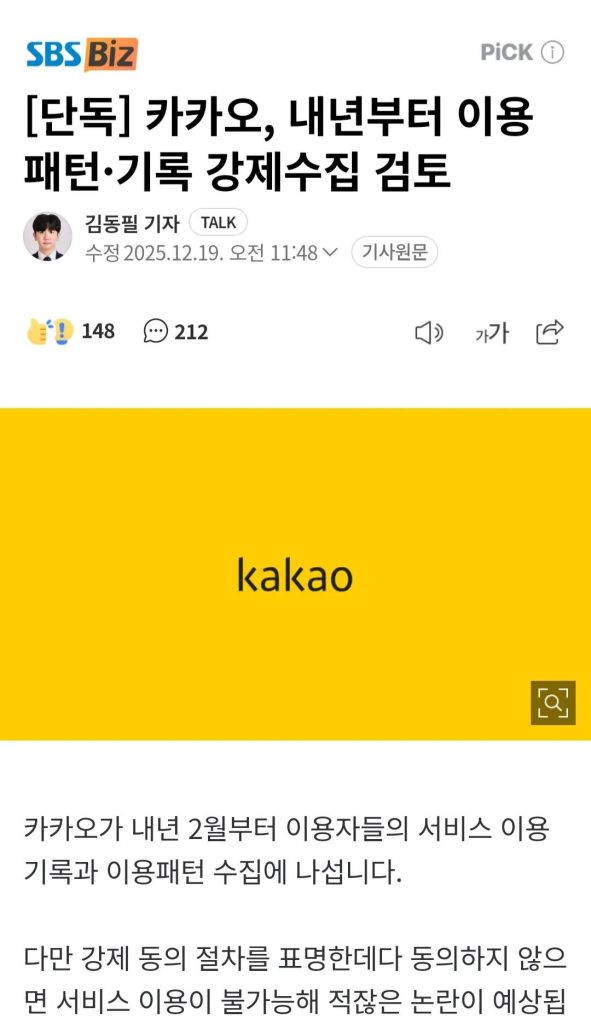

KakaoTalk, South Korea’s dominant messaging app, is poised to enforce a revised privacy policy starting in February 2026 that will effectively require users to allow the collection of detailed usage records and behavior patterns if they want to continue using the service. Reports indicate that if users do not actively reject this change, their consent will be presumed and refusal may lead to loss of access to the app. This policy shift has sparked widespread concern over intrusive data collection and the erosion of meaningful user choice.
1. Why “usage pattern collection” is sensitive — patterns can be more dangerous than content
Many companies say the same thing:
“We don’t read your messages. We only collect usage patterns.”
But in reality, usage patterns can reveal a person’s life with remarkable precision.
From usage patterns alone, it is possible to infer:
- Who someone communicates with, how often, and at what times
- Late-night, weekend, or specific day-of-week activity
- Changes in relationships (dating, divorce, conflict, or sudden silence)
- Family structure (parents, children, spouse)
- Work-life rhythms
- Periods of stress or crisis (sudden spikes or drop-offs in communication)
👉 Even without reading a single message,
👉 a combination of contact networks, frequency, and timing
👉 is often enough to reconstruct a detailed social graph of a person’s private life.
This is not speculation.
It is a well-established fact in academic research.
2. KakaoTalk’s unique position: a “private messenger” that functions as essential infrastructure
KakaoTalk is not just another app.
In practice, it functions as essential social infrastructure in South Korea:
- Used by the overwhelming majority of the population
- Embedded in family life, workplaces, schools, government offices, hospitals, and real estate transactions
- Largely non-substitutable in everyday life
In this context, the statement:
“If you don’t agree, don’t use the service”
effectively means:
“If you don’t agree, step out of social life.”
That is not what free and voluntary consent looks like.
3. The “20 years of private history” problem — the core of public anxiety
This is the point many people instinctively feel but struggle to articulate.
Over nearly two decades, people have shared on KakaoTalk:
- Romantic relationships
- Family conflicts
- Photos of their children
- Medical information
- Voice messages
- Personal files
- Their most emotionally vulnerable moments
People did not use KakaoTalk as a corporate platform.
They used it as a private space.
That is why usage-pattern collection feels less like:
“We are starting to observe you now”
and more like:
“We are turning your entire history of relationships into an object of analysis.”
This is not a routine data-policy update.
It feels closer to a collapse of psychological trust.
4. It may be “legal” — but is it legitimate?
Under Korean data protection law, formal legality can be achieved if:
- The purpose is specified
- Data collection is minimized
- User consent is obtained
But this is the real issue 👇
⚠️ Legality does not equal legitimacy
- Consent without a real alternative
- A monopolized social infrastructure
- Network effects that make exit practically impossible
- Contact-network data that does not belong to one individual alone
👉 Ethical and democratic legitimacy is a separate question.
5. The most serious issue: contact-network data is not personal property
When one person consents, it does not affect only them.
Their:
- Family members
- Friends
- Colleagues
are automatically pulled into the analytical system.
This goes beyond the scope of individual consent.
Contact-network data is:
- Collective information
- A form of social power data
This is why the European Union treats such data far more strictly, and why there is a strong consensus there that metadata can be more dangerous than content.
6. This is a serious problem.
This is not merely an IT service policy change.
It involves:
- A redefinition of the private sphere
- The erosion of meaningful consent
- One-sided expansion of platform power
- Long-term encouragement of self-censorship
In a country like South Korea, with:
- A historically sensitive relationship to freedom of expression
- A structural closeness between political power, platforms, and public life
this issue demands particular caution.
7. Summary
When a messenger that functions as de facto social infrastructure comprehensively collects usage patterns and contact-network data, while excluding those who do not consent, free and meaningful consent is difficult to claim regardless of formal legality. Such a measure turns entire private relationship networks into objects of analysis, reflects a clear power imbalance, and raises serious questions that require public debate and genuine choice in a democratic society.